

Esther Part 1 – “Where’s God?”
Esther is unique among the sixty-six books of the Bible because it is the only book in God’s Word that does not contain the name of God. God’s presence is on every page of Esther, but His name is nowhere to be found. Which raises the question of why God would include in His Word a book that never mentions His name. One reason is that God wanted to use this story to teach us something about Himself that is critical for your life and mine, which is this: there are many times in our lives when it seems that God is nowhere to be found but He is indeed at work to accomplish His purposes. There are times in life when we say, “Where’s God?” There are many times in our circumstances when we look for God, but we can’t seem to locate Him. There are many times when it seems that God is letting things happen to us that He wouldn’t allow if He loved us and cared about us. And He doesn’t seem to be present when these painful circumstances are happening to us. There is a term for God’s seeming invisibility, when He cannot be located but He is indeed at work. It is referred to in biblical theology as the doctrine of His providence: God’s unseen hand at work.
The providence of God is a part of another doctrine, His sovereignty. The sovereign God whose name does not appear in the book of Esther is present and working on every page. So, we must get our theology straight first before we can appreciate the message of Esther.
God’s Sovereignty
- One of God’s chief theological attributes is His sovereignty.
- The word “sovereign” means God has absolute authority and complete control.
- God does as He pleases, only as He pleases, and always as He pleases.
- Sovereignty means His rulership over all of His creation.
- “In him we have obtained an inheritance, having been predestined according to the purpose of him who works all things according to the counsel of his will,” Ephesians 1:11 ESV
- “Our God is in the heavens; he does all that he pleases.” Psalm 115:3 ESV
- “remember the former things of old; for I am God, and there is no other; I am God, and there is none like me, declaring the end from the beginning and from ancient times things not yet done, saying, ‘My counsel shall stand, and I will accomplish all my purpose,’” Isaiah 46:9-10 ESV
- That is sovereignty.
- He is in charge of all things, because He has created all things.
Humanity has freedom to make choices,
- I believe that God in His sovereignty has given humanity the ability to make choices, He created us with the capacity to obey or disobey, to accept Him or reject Him.
- We are not robots that are preprogrammed.
- The Word of God repeatedly uses words like, “if you believe”, “if you love”, “if you obey”, “chose”, “trust”, “whoever believes”, “if you confess”, “seek”, “ask”. I believe these words indicate that humanity has the free ability to make decisions, choices,
- God is supremely sovereign, and we are responsible for our response to Him and responsible for our behavior.
- I love the answer Baptist Preacher Charles Spurgeon gave over 100 years ago when someone asked him how he reconciled God’s sovereignty and human responsibility: “I wouldn’t try,” he replied, “I never reconcile friends.”
- In the Bible, divine sovereignty and human responsibility are not enemies. They are friends. They work together.
Providence
- God is sovereign, and He grants humanity freedom, but He will not allow that freedom to stop His sovereignty. He must sew or weave that freedom together to fulfill His sovereign purpose.
- God’s providence is the miraculous and often mysterious way He intersects and interconnects people and events to bring about His sovereign will and purposes, what He wants to happen.
- Providence is often mysterious. We may not see God’s hand at work, but He is indeed working and controlling the action by either causing or allowing things to happen.
- Esther’s story reveals that God will providentially either cause or allow things to happen that may be in contradiction to what He wants in order to achieve His ultimate, sovereign plan.
- One of the classic illustrations is the life of Joseph, particularly as Joseph sums up his experience. (Genesis 37-50)
After having been sold into slavery by his brothers, enduring mistreatment in Egypt, rising to the right hand of Pharaoh, and reconciling with his family, Joseph tells his brothers, “As for you, you meant evil against me, but God meant it for good, to bring it about that many people should be kept alive, as they are today” (Genesis 50:20). When Joseph’s brothers sold him into slavery, they had only a sinful intent to do away with him. That was their motive and that was the reason for their action. The Lord, however, had a different plan. He wanted to get Joseph into Egypt so that Joseph could finally join the court of Pharaoh and save not only the world from famine but particularly the chosen line of Abraham. God allowed and used Joseph’s brothers’ evil to accomplish His purpose of getting Joseph to Egypt. The sovereign God wove together the free choices of Joseph’s brothers and many Egyptians to get Joseph to where he needed to be when he needed to be there.
- When you begin to understand God’s sovereignty and His providential ways of achieving His will, you you start to become more aware of His involvement even when He seems absent.
- Because of this we can trust God even when we cannot trace His hand at work in our lives.
- The book of Esther was written so you would see where His name does not appear and no reference of Him is seen that He is very vitally there.
The book forms a chiastic structure. (The various parts mirror each other.)
A. Opening and background (1:1-22)
B. The king’s first decree (2:1-3:15)
C. The clash between Haman and Mordecai (4:1-5:14)
X. “On the night the king could not sleep” (6:1)
C’ Mordecai’s triumph over Haman (6:1-7:10)
B’ The king’s second decree (8:1-9:32)
A’ Epilogue (10:1-3)
Esther Chapter One
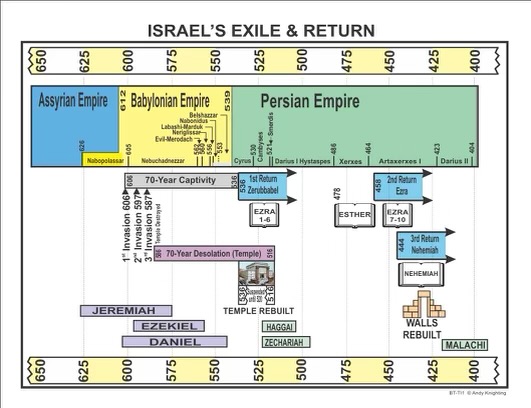
Now to understand the story, it helps to understand two other books of the Bible, Ezra and Nehemiah, because Esther is happening during the time of Ezra and Nehemiah. God told Ezra to go back to Jerusalem and rebuild the temple. God will send Nehemiah back to Jerusalem to build back the city walls and build back the city. God had told the Jews when I set you free, you are to go back to Jerusalem which is my city under my covenant and under my covering. The book of Esther occurs in Persia with Jews who did not go back.
The return of the exiles to Judah and the rebuilding of Jerusalem were carried out in three waves. The first return was around 536 B.C. under the leadership of a man named Zerubbabel. It was during this period that the people of Israel built the second Temple. About sixty years later, a second group, under the priestly leadership of Ezra, returned to the land. Spiritual and religious reformation occurred at that time. Finally, under the leadership of Nehemiah, a king’s cupbearer, many more returned. Nehemiah’s focus was to repair Jerusalem’s walls and gates.
“The opening chapter has set the tone that cannot be forgotten, conditioning the reader not to take the king, his princes, or his law at their face value, and alerting the reader to keep his eyes open for ironies that will doubtless be implicit in the story that is yet to unfold.” – David Clines, The Esther Scroll:The Story of the Story

 Living Hope Ministries