

The Good “R” and the Bad “R”
There’s only one thing that can send someone to hell for eternity. You know what it is? Unforgiven sin. Nobody goes to hell because of being harassed by the devil. Nobody goes to hell because of being possessed by the devil. Nobody goes to hell because of being oppressed by the devil. People go to hell for one reason: unforgiven sin. Period. That’s all. Satan has one way to get you to hell: to keep your sins from being forgiven. Because this is true, what do you think Satan and all his evil buddies are giving all their time and energy to? To keep as many people living in their sin as they can, to keep as many people as possible from recognizing their need for a Savior who can and does offer forgiveness for their sin.
Acts 2:36-40
Peter had preached the Gospel, and they were cut to the heart (vs 37); in other words, they felt convicted. They realized they were in a bad place; they had sinned against God; their sin had contributed to the death of the Son of God. They cry out, “What shall we do?” “And Peter said to them, “Repent and be baptized every one of you in the name of Jesus Christ for the forgiveness of your sins, and you will receive the gift of the Holy Spirit.” (Acts 2:38 ESV) Peter’s answer to them and to us is repent and be baptized. The doorway into grace, salvation, forgiven sin, and relationship with Jesus is repentance. Peter is not teaching that baptism saves you; he’s teaching that what baptism portrays or represents saves you. Dying to self and our attempts to save ourselves and living in the finished work of Jesus.
What is repentance? (The good “R”)
The word used here for repentance is “metanoeō”. The literal meaning is to change one’s mind, but the meaning carries with it more than just a thinking differently about something. A change of mind about sin and about God, which results in turning from sin to God. True repentance requires humility and vulnerability, recognition that you were wrong, lost, broken, helpless, in opposition to God. A desperation and a recognition for things to change. A recognition that sin is against a holy and just God, that our sin grieves God, it betrays God. Brokenness not just because we got caught or it inconveniences us but because we have opposed God.
Another word that is used in the New Testament to communicate this idea of repentance is “epistrephō”. “to open their eyes, so that they may turn from darkness to light and from the power of Satan to God, that they may receive forgiveness of sins and a place among those who are sanctified by faith in me.’” (Acts 26:18 ESV) This refers to a change of purpose or direction. From darkness to light, from the power of Satan to God.“For they themselves report concerning us the kind of reception we had among you, and how you turned to God from idols to serve the living and true God, and to wait for his Son from heaven, whom he raised from the dead, Jesus who delivers us from the wrath to come.” (1 Thessalonians 1:9-10 ESV) Paul describes the conversion of the Thessalonians as a turning from idols to serve the Lord. Conversion here refers to a “clean break,” a decisive, whole-hearted decision to turn from idols to serve the living God.
What shall we do?
When the people say, “What must I do?” it’s clear that they feel a need. They are saying, “I need something. What must I do to get it?” Peter gives two explicit answers in verse 38 to what they need, what we need. “And Peter said to them, “Repent and be baptized every one of you in the name of Jesus Christ for the forgiveness of your sins, and you will receive the gift of the Holy Spirit.” (Acts 2:38 ESV) He says they need forgiveness, and they need the gift of the Holy Spirit.
Let’s stop here for a minute and do some thinking. What if there is no repentance? Then there is no forgiveness of your sins and no gift of the Holy Spirit. This means there is no salvation. What does there need to be before there can be repentance? A recognition of sin. A realization of being in opposition to God. Accepting that God is right, and you are wrong. There is absolute truth and you’re not it. Let’s put two things together here: 1) The only lethal weapon Satan has is unforgiven sin. 2) True biblical repentance is the doorway to forgiveness of sin and receiving the gift of the Holy Spirit. So, if Satan wants to keep you from receiving forgiveness, and you receive forgiveness through repentance, what do you think Satan is going to try and prevent? How do you think he is doing that?
Relativism (The bad “R”)
Is there a mindset or a worldview that could undermine the need for repentance and therefore prevent true salvation? I believe that relativism is keeping people from salvation and robbing disciples of Jesus from power because it undermines the need for repentance. Relativism is the belief that there are no absolute truths, instead, each individual can have his or her own set of beliefs and values, and none can be judged as being more right or wrong than another. This idea allows for a great deal of personal freedom when it comes to religion; however, it also means that no one religion can be considered objectively true or good. Relativism is often expressed in phrases like “my truth” and “your truth.”
Christianity differs from relativism because it holds that there is one true God who created everything in existence, including us. Christianity holds that God is sovereign over all things and He and His Word are absolute truth. Christians believe in salvation through Jesus Christ alone, not through any other religious figure or practice, nor through accumulation of good deeds. Christians believe absolute truth is rooted in all of the Scripture while adherents to relativism do not necessarily accept any one source as being authoritative or true over another source. According to Christian teachings, our moral behavior should reflect the character of God Himself, that God sets the standard for us to follow.
On the other hand, religious relativists believe that morality can change depending on different cultural contexts. What may be acceptable in one culture may not be acceptable in another culture, it’s all relative. Most relativists won’t question certain truth like, 2 + 2 = 4 or that the 49ers are the greatest NFL team. But they will argue against the absolute truth behind moral and ethical principles. This reveals that they are rebelling against God and His authority over their individualism and personal choices.
It sounds gracious on the surface, to say that God has no law, no standards, no expectations, no commandments, no threats, that He is simply there to affirm in whatever you happen to be. That sounds like grace and freedom. But there is one massive glitch. It destroys forgiveness. Where there is no absolute truth, no law, no just standard, no sovereign God who is absolute, there will be no repentance and no forgiveness of sins. And where there is no forgiveness there is still sin and where there is sin there is no salvation. Relativism is a deadly thing.
Forgiveness
So, I present you a biblical hope, not a relativistic one. These people in verse 37 were cut to the heart because they saw that God had made Jesus Lord and Christ, but they had killed Him. In other words, they were utterly at odds with God. They were living against His will. They were out of step with His character. They were in violation of His Word and His Son. God was one way. They were another way. And they did not have His affirmation. What they desperately needed (and what we need), and what God, in amazing grace was ready to give, was forgiveness. They had offended God. They had violated God. They had disobeyed God. And there was only one hope, that God might find a way to be the holy God that He is and yet forgive. Which is exactly what He did in the death of His Son.
So, I take the words at the end of verse 40 and apply them to all of us this with all the urgency that I can: “And with many other words he bore witness and continued to exhort them, saying, “Save yourselves from this crooked generation.”” (Acts 2:40 ESV) And the most crooked thing about this generation is that we have created ways of salvation without God and therefore without law and therefore without forgiveness, and therefore utterly without hope. But I declare based on God’s Word that there is a God, there is absolute truth, and in the name of Jesus Christ there is forgiveness.
“Since therefore the children share in flesh and blood, he himself likewise partook of the same things, that through death he might destroy the one who has the power of death, that is, the devil, and deliver all those who through fear of death were subject to lifelong slavery.” Hebrews 2:14-15 ESV
- Jesus became flesh because you and I are flesh.
- Satan’s one lethal weapon is unforgiven sin; Jesus died to make a way for my sin and your sin to be forgiven so that He might destroy the only lethal weapon He has against you.
- Jesus took the punishment you and I deserved so the wrath of God has been satisfied for all those who repent and by grace through faith receive this gift of salvation.
- It means the one who had the power of death to destroy you no longer has that power.
- It’s gone. Why? Because the law is satisfied, and sins are forgiven.
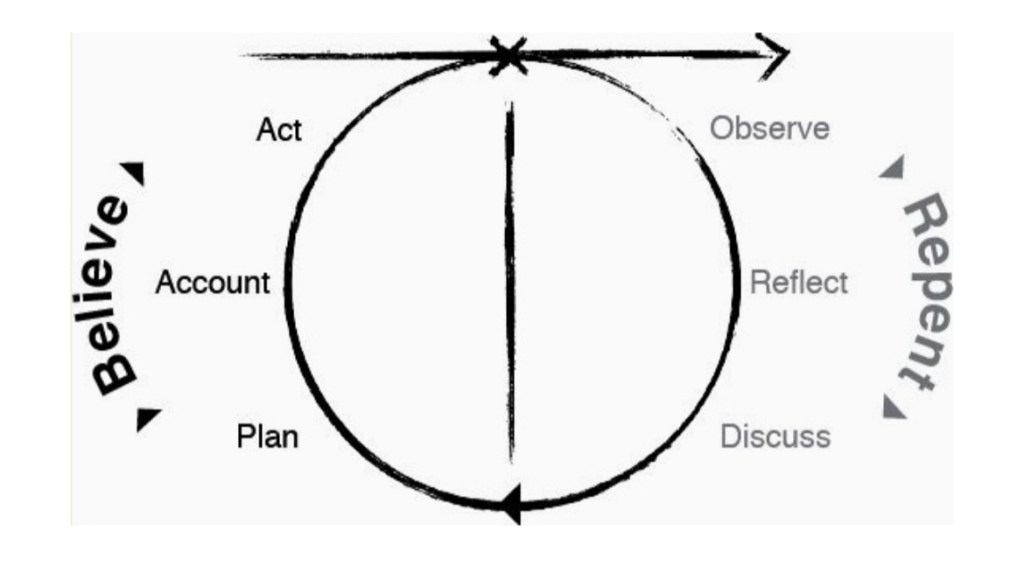
- The question is, “Will you repent and believe in the Gospel?”
Jesus – “The time is fulfilled, and the kingdom of God is at hand; repent and believe in the gospel.”” (Mark 1:15 ESV)
- The word for time is kairos. A kairos is an opportunity, an occasion for something, a God moment.
- When you have an encounter with God, a kairos, when “the Kingdom of God is near,” you can ignore it and keep going like nothing ever happened (take the straight line), or you can “repent” and “believe,” take the circle.

 Living Hope Ministries