

Knowing God = Trusting God
“I am the vine; you are the branches. Whoever abides in me and I in him, he it is that bears much fruit, for apart from me you can do nothing.” John 15:5 ESV
Abide means to continue, dwell, endure, be present, remain. In this context of the vine and the branches it is the idea of living fully surrendered to Jesus, remaining fully dependent on Him, fully reliant upon Him.
So where do we start? If we want to be a people who are abiding in Jesus and bearing fruit where do we start? Do we just start abiding? Just get good and determined, surrender everything we are and start living in complete and continual dependence on Jesus? I don’t believe that is what Jesus or the Word is calling us to. Yes, we should want to abide and even be determined to abide in Jesus, but I don’t think that is where we start the process. The following is what I believe gives a biblical picture of the process.
We glorify the Father by bearing fruit
Our ultimate purpose is to glorify God. To worship Him, to praise Him, to magnify His greatness, to honor Him. “By this my Father is glorified, that you bear much fruit and so prove to be my disciples.” (John 15:8ESV) Bearing fruit results in glorifying the Father. What is it that results in bearing fruit?
We bear fruit by abiding
“I am the vine; you are the branches. Whoever abides in me and I in him, he it is that bears much fruit, for apart from me you can do nothing.” (John 15:5 ESV) We glorify the Father by bearing fruit, and we bear fruit by abiding. What causes us to abide? What needs to be there before we will be willing to surrender and become completely dependent on Jesus and than bear fruit that leads to glorifying the Father?
We abide when we trust
I believe that we will only abide, surrender and remain completely dependent and reliant on Jesus, to the extent that we trust Jesus. I’m arguing that before we will abide, we must trust. The extent to which you will surrender and be dependent on God is equal to the extent to which you trust God. Before we are willing to obey, we must trust and believe that the one giving the commands or directions is trustworthy. Trust does not mean we will always understand. It means that even when circumstances make no sense, or things are hard and painful we continue to remain confident and reliant upon God. Where does trust come from? Do we just decide and determine that we will trust this person or that person?
We trust when we know.
“And those who know your name put their trust in you, for you, O Lord, have not forsaken those who seek you.” (Psalm 9:10 ESV) Trusting = knowing. We live in a day and time of conditional statements. Everything is maybe, possibly, perhaps, sometimes. But here is a bold statement without apology. Those who know the name of the Lord WILL trust in the Lord. There is no might, no should, no maybe, and no mostly. Those who know God’s name WILL trust Him. The original word the writer uses for “know” doesn’t merely mean head-knowledge. It implies an intimate understanding gained through personal experience. It’s difficult to trust God with all our heart if we aren’t acquainted with His. Our willingness to trust is rooted in our awareness of His love.
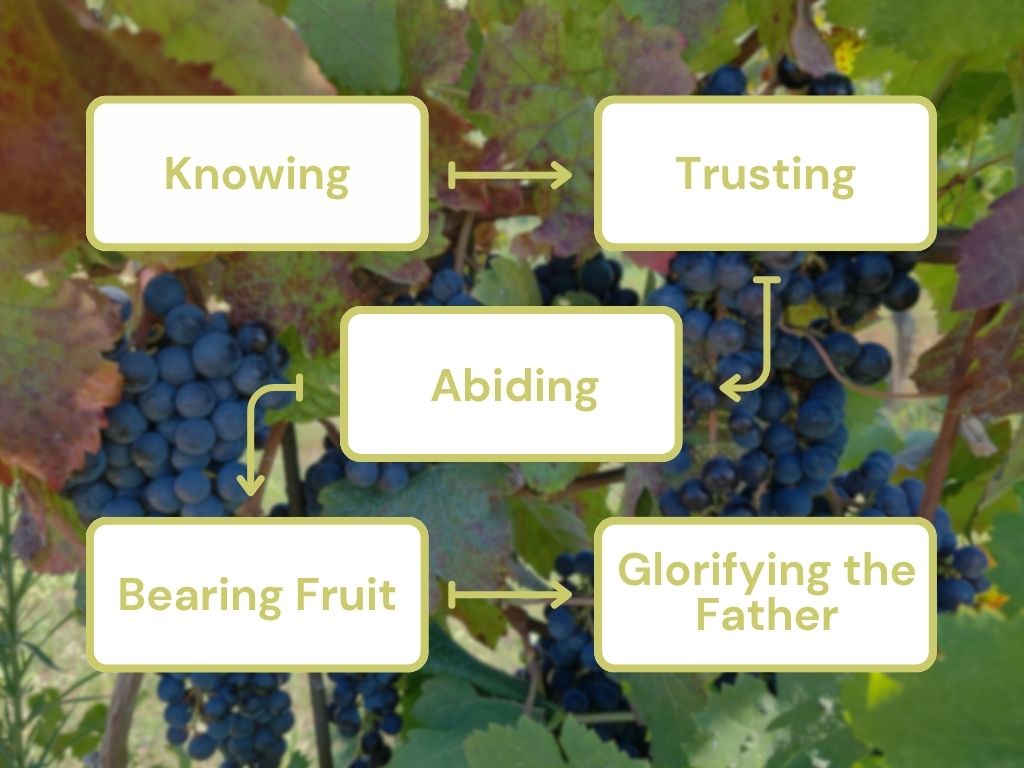
Two weeks ago, we thought about the idea that we need to be with Jesus before you do for Jesus. We need to be with Jesus to know Jesus, and when we know Jesus we will trust Jesus, and when we trust Jesus we will abide in Jesus, and when we abide in Jesus we will bear fruit, and when we bear fruit the Father is glorified.
Knowing leads to trusting; trusting leads to abiding; abiding leads to bearing fruit; bearing fruit leads to glorifying God.
Knowing God is the remedy for all of our anxieties, worries, fears, and doubts. Knowing God is our weapon against every temptation that comes our way. As painful as this may sound, unbelief is the root of all our anxieties and fears, unbelief is the cause of all our sins. I believe that the enemy’s primary point of attack will be our trust or belief in God. If the enemy can cause unbelief (lack of trust) than we will not abide as we should, if we are not abiding, we will not bear fruit, and if we are not bearing fruit our lives will not be glorifying the Father.
If what I am saying is correct, then the way we must fight the fight of faith (belief and trust) is by knowing God. We fight by getting to know who God is, we fight by reminding ourselves and each other who God is, what God has done. We fight anxieties, fears and doubts with the promises a faithful God has made.
Suppose you are in a car race and your enemy, who doesn’t want you to finish the race, throws mud on your windshield. The fact that you temporarily lose sight of your goal and start to swerve does not mean that you are going to quit the race. And it certainly doesn’t mean that you are on the wrong racetrack. What it means is that you should turn on your windshield wipers and squirt some washer fluid.
When anxiety strikes and blurs our vision of God’s glory and the greatness of the future that He plans for us, this does not mean that we are faithless, or that we will not make it to heaven. It means our faith is being attacked. At first blow, our belief in God’s promises may sputter and swerve. But whether we stay on track and make it to the finish line depends on whether, by grace, we set in motion a process of resistance, whether we fight back against the unbelief of anxiety. Will we turn on the windshield wipers (the Word of God) and squirt the washer fluid (the Holy Spirit)?
The following are some examples of what this may look like:
- When I am anxious about some risky new venture or meeting, I battle unbelief with the promise: “Fear not, for I am with you; be not dismayed, for I am your God; I will strengthen you, I will help you, I will uphold you with my righteous right hand” (Isaiah 41:10).
- When I am anxious about my ministry being useless and empty, I fight unbelief with the promise: “So shall my word be that goes out from my mouth; it shall not return to me empty, but it shall accomplish that which I purpose, and shall succeed in the thing for which I sent it” (Isaiah 55:11).
- When I am anxious about being too weak to do my work, I battle unbelief with the promise of Christ: “My grace is sufficient for you, for my power is made perfect in weakness” (2 Corinthians 12:9).
- When I am anxious about decisions I have to make about the future, I battle unbelief with the promise: “I will instruct you and teach you in the way you should go; I will counsel you with my eye upon you” (Psalm 32:8).
- When I am anxious about facing opponents, I battle unbelief with the promise: “If God is for us, who can be against us?” (Romans 8:31).
- When I am anxious about the welfare of those I love, I battle unbelief with the promise that if I, being evil, know how to give good things to my children, “how much more will your Father who is in heaven give good things to those who ask him!” (Matthew 7:11).
- When I am anxious about being sick, I battle unbelief with the promise: “Many are the afflictions of the righteous, but the Lord delivers him out of them all” (Psalm 34:19). And I take the promise with trembling, “knowing that suffering produces endurance, and endurance produces character, and character produces hope, and hope does not put us to shame, because God’s love has been poured into our hearts through the Holy Spirit who has been given to us” (Romans 5:3–5).
- When I am anxious about getting old, I battle unbelief with the promise: “Even to your old age I am he, and to gray hairs I will carry you. I have made, and I will bear; I will carry and will save” (Isaiah 46:4).
- When I am anxious about dying, I battle unbelief with the promise that “none of us lives to himself, and none of us dies to himself. For if we live, we live to the Lord, and if we die, we die to the Lord. So then, whether we live or whether we die, we are the Lord’s. For to this end Christ died and lived again, that he might be Lord both of the dead and of the living” (Romans 14:7–9).
- When I am anxious that I may make shipwreck of faith and fall away from God, I battle unbelief with the promises: “He who began a good work in you will bring it to completion at the day of Jesus Christ” (Philippians 1:6); and, “He is able to save to the uttermost those who draw near to God through him, since he always lives to make intercession for them” (Hebrews 7:25).
“And this is eternal life, that they know you, the only true God, and Jesus Christ whom you have sent.” John 17:3 ESV

 Living Hope Ministries