
Esther part 3 – “Still at War”
“In Hebrew narrative the characteristic described when a character is introduced is key to understanding his or her role in the story.” (A Commentary of Esther, Karen Jones) When Mordecai is introduced in chapter 2 verse 5 he is identified not as a wise man or as an official in the court, but as a Jew of the tribe of Benjamin. When Haman is introduced, he is identified as an Agagite. Agag was the king of the Amalekites at the time Saul (also of the tribe of Benjamin) was the first king of Israel. The Amalekites were a nomadic people of the southern desert region who frequently raided Israel from the beginning of its history. This heathen nation had the distinction of being the first people of the world to attack and try to destroy God’s newly formed covenant nation. So, the author is implying that the relationship of enmity between the Jews and the Agagites is mirrored in the personal relationship between Mordecai and Haman. The original readers would expect the relationship to be characterized by conflict and aggression.
Exodus 17:8-16, Deuteronomy 25:17-19, 1 Samuel 15
- Amalek, a descendant of Esau, is a type (representation, example, a foreshadowing) of the flesh; that is, the evil and corrupt nature of man, the sinful element of human nature.
- Charles Spurgeon says about Exodus 17, “We think that the journeys of the children of Israel furnish us with many emblems of the journey of God’s church through the world; and we believe, that this fight with Amalek is a metaphor and an emblem of that constant and daily fight which all God’s people must carry on with sins without and sins within.”
- Dr John MacArthur writes that “The Amalekites are a perfect illustration of the sin that remains in the believer’s life. That sin—already utterly defeated at the cross—must be dealt with ruthlessly and hacked to pieces, or it will revive and continue to plunder and pillage his heart and sap his spiritual strength. He cannot be merciful with his Agag, or indwelling sin will turn and try to devour him.
- Rod Mattoon adds that “This conflict between Israel and Amalek is a picture of the inward battle that Christians face every day. It is the battle between our flesh and the Spirit of God. Amalek means “a people that exhausts or consumes. The Amalekites are a picture of the sinful desires of our flesh that consume, destroy, and exhaust us like a person trying to free themselves from the bondage of a rope.”
- So not only will the LORD have war against Amalek from generation to generation, but so will the LORD’s children, for as Paul explains: “But I say, walk by the Spirit, and you will not gratify the desires of the flesh. For the desires of the flesh are against the Spirit, and the desires of the Spirit are against the flesh, for these are opposed to each other, to keep you from doing the things you want to do.” Galatians 5:16-17 ESV
- Scripture commands believers to deal with their sin by putting it to death: “Put to death therefore what is earthly in you: sexual immorality, impurity, passion, evil desire, and covetousness, which is idolatry. On account of these the wrath of God is coming.” Colossians 3:5-6 ESV
- John Owen wrote, “Be killing sin or it will be killing you.”
- Christians must be always at the task of killing sin.
Romans 8:11-13
- Notice that both our future resurrection and our current sanctification (putting to death the deeds of the body, becoming more like Jesus) are through or by the Holy Spirit.
- You don’t owe the flesh anything but enmity and war. You owe the Spirit of God everything. He is going to make you alive in the resurrection (verse 11), and even now, you can only have victory over your sins “by the Spirit” (verse 13).
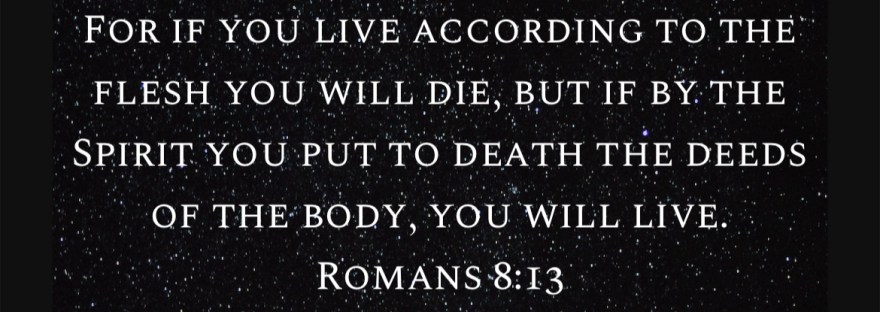
- If by the Spirit you put to death the deeds of your own body, you will live. Christianity is war — NOT AGAINST OTHER PEOPLE but on our own sinful impulses.
- So, the question we are asking and trying to answer is this: How do you by the Spirit put to death the deeds of the body?
Step 1: Set your mind on the things of the Spirit.
“For those who live according to the flesh set their minds on the things of the flesh, but those who live according to the Spirit set their minds on the things of the Spirit. For to set the mind on the flesh is death, but to set the mind on the Spirit is life and peace.” (Romans 8:5-6 ESV) You don’t simply look at the temptation and say no. That’s part of it. But if you are going to put it to death by the Spirit, you have to do more: you direct your mind, your heart, your spiritual focus another way, namely to the “things of the Spirit.”
“if you live according to the flesh you will die” (8:13)
“to set the mind on the flesh is death” (8:5)
“if by the Spirit you put to death the deeds of the body, you will live” (8:13)
“to set the mind on the Spirit is life and peace” (8:5)
Step 2: Set your mind on the words of God in Scripture.
What are the “things of the Spirit.” The only other place that Paul uses this phrase “things of the Spirit” is in 1 Corinthians 2:13-14. “And we impart this in words not taught by human wisdom but taught by the Spirit, interpreting spiritual truths to those who are spiritual. The natural person does not accept the things of the Spirit of God, for they are folly to him, and he is not able to understand them because they are spiritually discerned.” (1 Corinthians 2:13-14 ESV) Here we have the very phrase of Romans 8:5, “things of the Spirit.” What are they? The words of God, spoken by the apostles, taught by the Spirit, not human wisdom. So, to put to death the deeds of the body (as Romans 8:13 says) “by the Spirit” we must set our minds on “the things of the Spirit,” which we now see means set your mind on the words of God in Scripture. What enforces this idea is the connection with Ephesians 6:17 where Paul says in our battle against evil we must “take the helmet of salvation, and the sword of the Spirit, which is the word of God.” Among all the spiritual armor that we are to “put on” in our warfare there is only one offensive weapon that is used for killing. The sword. And what is it? It is described in two ways that link it with Romans 8:13.
- It’s the sword of the Spirit. So, if we are to kill the deeds of the body “by the Spirit,” and the one killing weapon in our armor is the sword and it is called “the sword of the Spirit,” we have good reason to think that the agent for killing sin “by the Spirit” is this sword.
- What is this “sword of the Spirit”? Ephesians 6:17 says it is “the Word of God,” which confirms our connection with 1 Corinthians 2:14. The sword that kills sin is the Word of God.
So, the way we kill sin “by the Spirit” is to set our minds on “the things of the Spirit,” that is, the word of God in Scripture, which is the sword of the Spirit.
Step Three: Set Your Mind on the Word of God in Scripture and hear with faith.
Very practically how do you use the sword of the Spirit which is the Word of God to put to death the deeds of the body? The answer is clear in Galatians 3:5, “Does he who supplies the Spirit to you and works miracles among you do so by works of the law, or by hearing with faith—” The answer is that the Spirit is supplied to us for the miracle of killing of sin not by works of the law but by “hearing with faith.” Why does he say, “by hearing with faith” instead of just “by faith”? We hear words. Paul wants to emphasize that it is “the word of God,” which is the sword of the Spirit, which kills sin. When temptation comes, along with a loud no, you look to a word from God, especially a word that promises He will be more for us and do more for us than what this sin promises. Sin is always promising you something, (pleasure, happiness, status, security, peace) but sin can never fulfill what it promises. So to defeat sin we don’t just try harder; we find truth, a better promise, a superior promise, a promise made by an all-powerful, all-knowing, loving, good, unchanging, eternal God. We hear that promise and we believe it, we trust it, we hear with faith, and we act on it. I will add that many of the promises of God that He has given us to give us hope and to kill sin in our lives are conditional promises. Conditional on our obedience. Obedience to His Word is absolutely necessary, faith is obedience, so if you want to kill sin in your life you read the Word, and in faith you obey the Word and receive the promise.
We Kill Sin the Same Way We Get Saved
- We kill sin the same way we get saved. “For by grace you have been saved through faith. And this is not your own doing; it is the gift of God, not a result of works, so that no one may boast.” Ephesians 2:8-9 ESV
- Faith, not works, is the way we are made right with God; and faith, not works, is the way we engage the Holy Spirit to kill sin.
- When Christ died for us, He bought with His blood both justification and sanctification. “For all the promises of God find their Yes in him. That is why it is through him that we utter our Amen to God for his glory.” 2 Corinthians 1:20 ESV And both are obtained by faith. You never outgrow your need to live by hearing with faith.
- Remember, this is war, it will not be easy. It may not be quick. The enemy will not just roll over. We must fight, we must persevere, we must fight FOR each other, and we must trust in the power and love of God Almighty and His Word.
Practical examples:
When you are afraid, feel alone, need help, or when you feel vulnerable or weak pull out the sword Isaiah 41:10, “fear not, for I am with you; be not dismayed, for I am your God; I will strengthen you, I will help you, I will uphold you with my righteous right hand.” Speak it to yourself, think about it, remember how God has been with you in the past, how He has been faithful to you in the past, how He has given you the strength you have needed in the past.
If you feel anxious about decisions you have to make about the future, battle unbelief with the promise, “I will instruct you and teach you in the way you should go; I will counsel you with my eye upon you.” (Psalm 32:8 ESV)
My most used promise to kill those small, temporary, fleeting pleasures that sin offers is Psalm 16:11, “You make known to me the path of life; in your presence there is fullness of joy; at your right hand are pleasures forevermore.” I remember how the promises sin offers have over and over let me down, disappointed me, left me empty and unsatisfied, hurt people I love, and dampened my intimacy with God. Then I look at, become overwhelmed with, the superior promise that is being offered, “fullness of joy” and “pleasures forevermore.” I remember the joy of intimacy with my Father. I dream of seeing Jesus face to face and the pleasure that will be forevermore. AND I KILL THE SPIDER.


